

This morning, millions of people around the world opened X (formerly Twitter), ChatGPT, Spotify, or their favorite news site — and were greeted with error pages. A single internal degradation at Cloudflare, one of the internet’s most critical infrastructure providers, created a cascading outage that reminded us all how fragile the hyper-centralized cloud has become.
Just a few weeks earlier, AWS’s US-EAST-1 region went down for over 15 hours, taking Snapchat, Reddit, Venmo, and countless other services with it.
These are not isolated incidents. They are symptoms of a deeper structural problem: too much of the internet now depends on too few providers. When one hyperscaler or CDN hiccups, half the digital economy grinds to a halt.
In this environment, forward-thinking companies are asking a simple but profound question: Do we really need to host everything in someone else’s data center halfway across the planet?
The answer, increasingly, is no. Welcome to the era of the Mini Data Center — private, sovereign, right-sized infrastructure that puts you back in the driver’s seat.
What Exactly Is a Mini Data Center?
Think of it as your own private cloud — but without the lock-in, surprise bills, or shared fate of the big public providers.
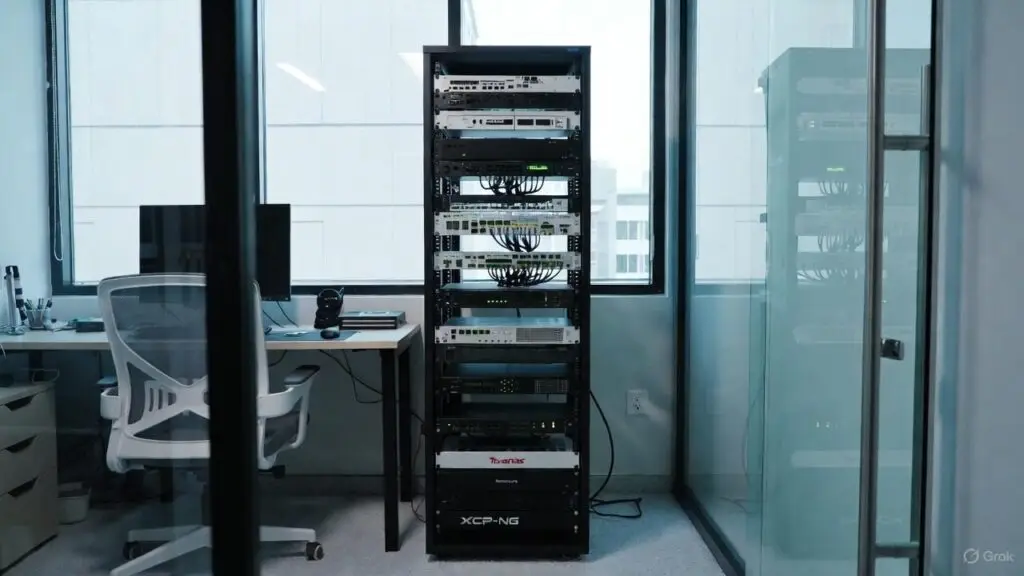
A Mini Data Center is a fully dedicated, physically secure facility ranging from a single locked cabinet to multiple racks, located in premium business districts and operated exclusively for your organization. You own or colo your servers, storage, and networking gear. You decide the security policies, the backup strategy, and the latency requirements. And yes — you can walk in, plug in a console, and manage it hands-on whenever you want.
At Client Navigator, we’ve taken this concept and made it accessible to businesses of every size — from fast-growing startups to established enterprises that are tired of public-cloud roulette.
Why Now? The Perfect Storm Driving Adoption
- Outrage Fatigue Today’s Cloudflare incident is just the latest in a string of high-profile outages (CrowdStrike in July 2024, Fastly in 2024, Microsoft Azure repeatedly in 2025). Companies are realizing that “five-nines” uptime promises don’t help when the entire internet is down at once.
- Data Sovereignty & Compliance New regulations in the EU, UK, UAE, Saudi Arabia, and even parts of Asia are making it risky — or outright illegal — to store certain data in U.S.- or China-controlled hyperscalers. A local Mini Data Center keeps you compliant without sacrificing performance.
- Exploding Egress & API Costs Many organizations that went “all-in” on public cloud five years ago are now facing bills that have tripled. Moving stable, predictable workloads back to owned or colo hardware often cuts costs by 40-70 %.
- AI & Edge Workloads Training and inference at the edge demand low latency and GPU density that public cloud struggles to deliver cost-effectively. A Mini Data Center in your city can house the exact NVIDIA or AMD silicon you need — without competing in the same queues as everyone else.
- Hybrid Is the New Normal Gartner predicts that by 2027, 70 % of enterprises will use a mix of public cloud, private cloud, and on-prem/colo. Mini Data Centers are the perfect bridge.
The Client Navigator Difference
We didn’t just bolt some racks into a basement. We built Mini Data Centers the way modern businesses actually want to use them:
- Prime business-district locations – minutes from your office, not hours away in an industrial zone.
- From 1 cabinet to full private suites – scale up (or down) without renegotiating contracts.
- Certified engineers on call – deployment, migration, 24/7 monitoring, and hands-on support included.
- Direct physical access – you or your team can visit anytime. No more begging a hyperscaler for a cage tour.
- Carrier-neutral connectivity – multiple Tier-1 fiber providers, direct cloud on-ramps (AWS Direct Connect, Azure ExpressRoute, etc.), and ultra-low-latency links to the public internet.
- Built-in resilience – N+1 power, cooling, fire suppression, biometric security, and optional generator/UPS extensions.
Whether you’re bringing workloads home from the public cloud (“repatriation”), keeping sensitive data on-premise while bursting to AWS when needed, or building a private AI cluster, the flexibility is yours.
Real-World Wins We’re Seeing Today
- A fintech company reduced monthly cloud spend by 62 % after moving transactional databases to their Client Navigator Mini Data Center.
- A media group cut video-transcoding latency from 800 ms to 40 ms by running GPU nodes locally.
- A healthcare provider achieved GDPR and local regulatory compliance overnight — without rewriting a single line of code.
The Bottom Line
The cloud was sold to us as the ultimate resilience play: “Never worry about hardware again.” Today’s Cloudflare outage — and the dozens before it — prove that narrative has limits.
In 2025 and beyond, the smartest companies won’t abandon the cloud entirely. They’ll use it strategically, while reclaiming control over the mission-critical pieces that can’t afford to blink when someone else’s router reboots.
That’s what a Mini Data Center delivers: sovereignty without complexity, performance without compromise, and peace of mind in an increasingly unpredictable digital world.
Ready to explore what a private Mini Data Center could do for your business? Drop us a line at https://www.clientnavigator.com/contact — we’d love to show you around.
Irakli Gagua Tech Writer & Infrastructure Observer Writing for Client Navigator