
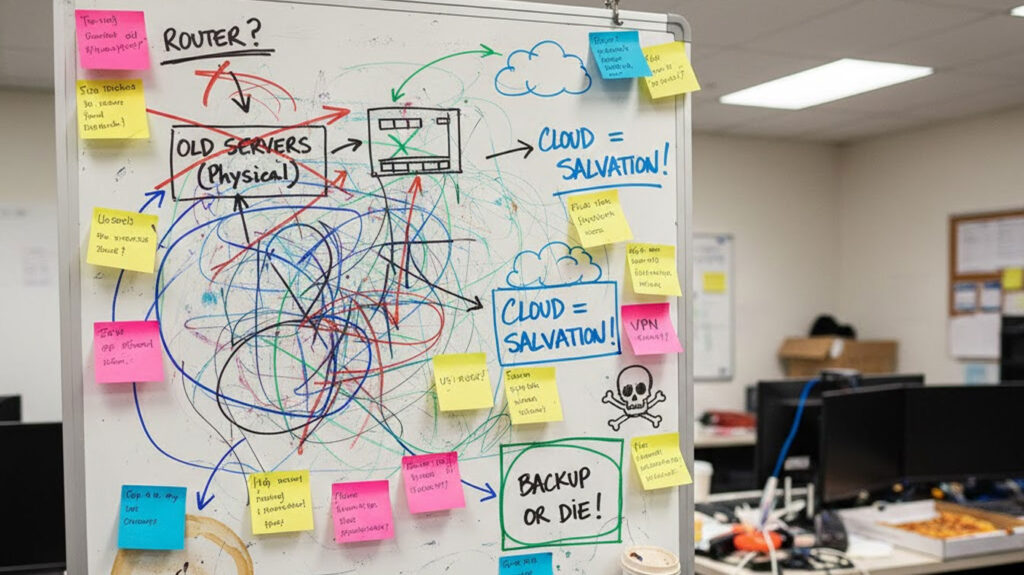

You’re the IT department. All of it. One person, 15–75 users, a mix of laptops that range from brand-new to “still running Windows 10 until yesterday,” printers that only work on Tuesdays, and a boss who thinks “the cloud” is where rain comes from. Welcome to the life of the modern small-office sysadmin in late 2025.
It’s equal parts liberating and terrifying. You get to call all the shots, learn ridiculously fast, and feel like a superhero when you fix something that was broken for months. But you’re also the single point of failure, the 24/7 on-call hero (whether you want to be or not), and occasionally the guy who gets asked to fix the coffee machine because “it’s electronic, right?”
Here’s your no-nonsense, battle-tested playbook for thriving—not just surviving—in this role.
1. Start with Brutal Honesty: The Day-One Audit
Your first month isn’t about fixing tickets. It’s about knowing what you’re dealing with.
- Document everything: network diagram (even if it’s a hand-drawn Sharpie masterpiece), passwords (use a proper vault like Bitwarden or 1Password Business), licenses, vendor contracts, backup status.
- Run a risk assessment: What’s the oldest server? When was the last backup tested? Any unpatched Windows 10 machines still lingering post-EOL? (Spoiler: there always are.)
- Present leadership with a short, scary-but-professional report: “Here’s where we could lose everything in 48 hours—and here’s what it costs to fix.”
This isn’t drama. It’s insurance. Good bosses respect the truth; bad ones fire the messenger. Either way, you win clarity.
2. Cloud-First or Die Trying (2025 Edition)
On-prem servers in small offices are like keeping a pet tiger: exciting until it eats you.
Push hard for Microsoft 365 + Intune + Entra ID (or Google Workspace + JumpCloud if you’re in a lighter ecosystem). Why? Because in 2025:
- Windows 11 upgrades are mandatory for security.
- Endpoint management at scale (even 50 endpoints) is impossible without MDM.
- Auto-updates, conditional access, and autopilot provisioning let you onboard new hires in minutes instead of days.
Minimize physical hardware. If you must have a file server, make it a NAS with cloud sync (Synology + OneDrive/SharePoint hybrid). And guest WiFi? Isolate it properly—your liability depends on it.
3. Automate Like Your Sanity Depends on It (Because It Does)
Time is your only non-renewable resource. Spend it wisely.
Top automation wins for solo admins right now:
- Scripted imaging/provisioning — Autopilot + Intune makes new laptops “just work” out of the box.
- Patch management — WSUS is dead; let Microsoft handle it via Intune.
- Alerts & monitoring — Use free/cheap tools like Zabbix, UptimeRobot, or Microsoft Defender alerts. Get pinged when things go sideways, not when users scream.
- PowerShell + Microsoft Graph — Automate user creation, license assignment, password resets. One script can save you 50 tickets a month.
The golden rule: If you do it more than twice, automate it.
4. Build Your Safety Net (Because You’re Not Superman)
Solo doesn’t mean alone.
- Partner with an MSP for after-hours emergencies and vacation coverage. Negotiate hourly “break-fix” rates upfront.
- Create a disaster recovery playbook — what happens if you get hit by a bus (or ransomware)? Who calls whom?
- Document SLAs internally: “Critical issues: same day. Everything else: best effort within 48 hours.” Post it. Enforce it.
And take your vacations. The company survived before you; it’ll survive a week without you if you’ve built it right.
5. The Human Side: Relationships > Root Access
Technical skills get you hired. Soft skills keep you sane.
- Train users relentlessly (nicely) on phishing, password managers, and “don’t click that.”
- Say “no” professionally when needed: “We can do that, but it costs $X and Y weeks—here are three cheaper/faster alternatives.”
- Celebrate wins publicly: “Fixed the printer for Marketing—now they can print color again!” Small victories build trust.
Remember: You’re not just keeping computers running. You’re keeping the business running. Own that.
The Bottom Line
Being the lone IT guardian in a small office in 2025 is still tough—but it’s easier than ever thanks to cloud tools, AI-assisted scripting, and mature endpoint management. The companies that thrive are the ones where the sysadmin treats IT like a strategic asset, not a cost center.
You’ve got this. Stay paranoid about backups, ruthless about automation, and kind to your users. The coffee machine? That’s someone else’s problem.
(But if it really is broken… yeah, you’ll probably fix it anyway.)